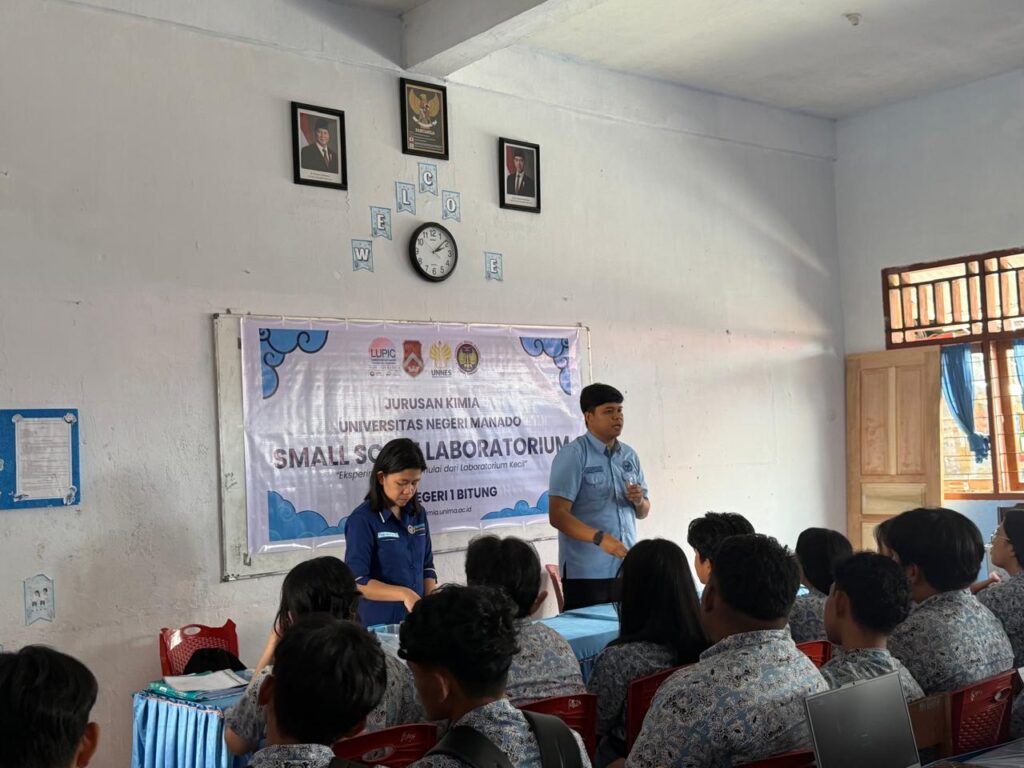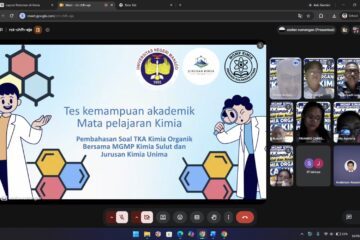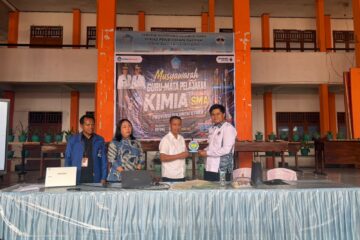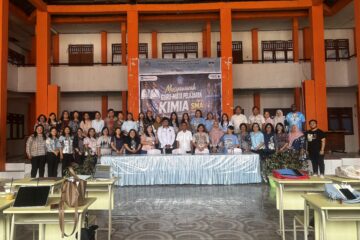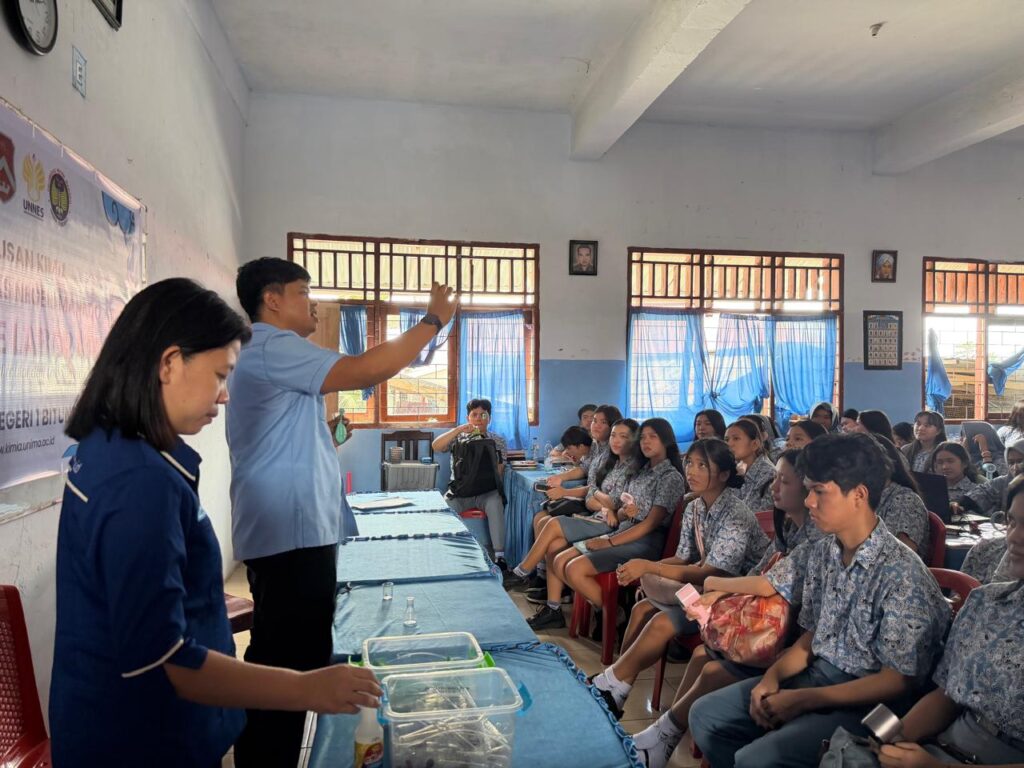
Universitas Negeri Manado, through the Faculty of Mathematics, Natural Sciences, and Sports (FMIPAK), carried out a Community Service Program titled “Introduction of Small Scale Laboratory to Support SDG 4 and SDG 17 at SMAN 1 Bitung.” The program was led by Dr. Anderson Arnold Aloanis, M.Si, with Vlagia Indira Paat, M.Si as team member. This initiative was designed to address the limited laboratory facilities at the partner school, as stated in the report that “the limited availability of equipment, materials, and operational costs often becomes a major obstacle in conducting laboratory-based learning in schools.” These constraints have resulted in science learning that is predominantly theoretical, providing minimal opportunities for students to engage in hands-on experimentation.
Through the small scale laboratory approach, the team introduced practical methods using simple, safe, and low-cost tools such as mini test tubes, droppers, small measuring cylinders, and alternative heating devices. This approach enables students to conduct experiments efficiently while reducing chemical waste and maintaining safety. Teachers and students at SMAN 1 Bitung received training, experiment demonstrations, and opportunities to practice directly using small-scale laboratory equipment aligned with the high school chemistry curriculum. The program was also supported with printed modules, digital materials, video demonstrations, and activity documentation to ensure long-term usability of the learning resources.
This initiative contributes significantly to SDG 4 (Quality Education) by providing an inclusive and accessible alternative for practical science learning, and to SDG 17 (Partnerships for the Goals) by strengthening collaboration between universities and schools. The program reflects UNIMA’s commitment to expanding educational partnerships and promoting innovative learning models that can be replicated in other schools facing similar facility limitations. The implementation of this activity was supported by PNBP UNIMA Funding for 2026 and received additional support from LUPIC (Leading University Project for International Cooperation) as part of ongoing international collaboration. LUPIC’s involvement enhanced the program through knowledge transfer, development of learning media, and capacity building for teachers and students.
Overall, this community service program demonstrates that limited facilities do not hinder meaningful, contextual, and sustainable science learning. The small scale laboratory model empowers students to learn through direct experimentation, encourages teachers to adopt innovative teaching practices, and reinforces UNIMA’s role in advancing science education across North Sulawesi.